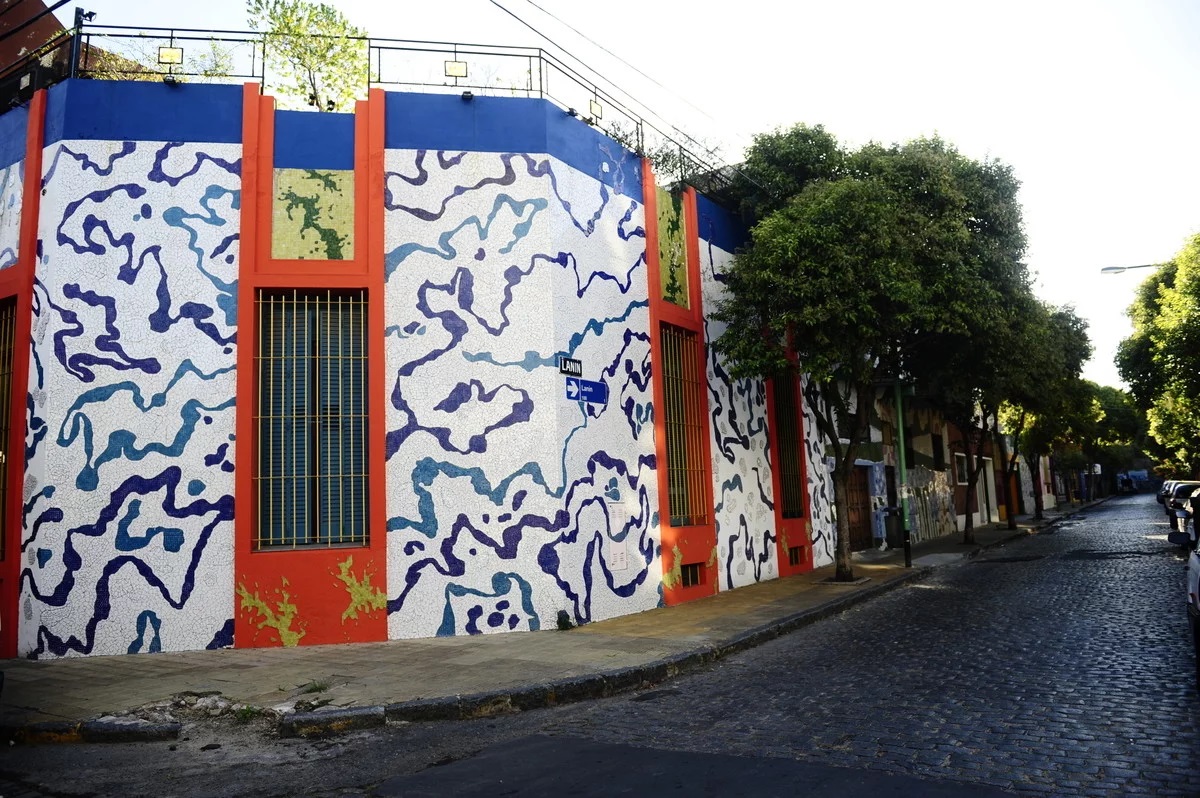
Pasaje Lanín: The Colorful Mosaic Street in Buenos Aires
Pasaje Lanín is a short street in Barracas, Buenos Aires, known for the painted façades and colorful mosaics created by artist Marino Santa María. The public art project extends across three blocks, between Brandsen and Avenida Suárez, bringing abstract designs into the everyday setting of a residential neighborhood.
You may also see it called Calle Lanín or Lanín Passage. Whatever the name on your map, the attraction is the same: a street where the fronts of homes have become part of a shared artwork.
From a distance, the colors draw you in. Up close, the small tiles, broken ceramic pieces and curves invite you to slow down and look at how each façade has been transformed.
How did Pasaje Lanín become an art project?
The transformation began with Marino Santa María’s own studio façade during the 1990s. Neighbors liked the result and asked him to work on the fronts of their homes too.
That interest helped turn an individual intervention into a larger neighborhood project. Instead of displaying paintings in a gallery, Santa María could bring his visual language into a place people passed through every day.
The first painted stage was inaugurated on April 19, 2001. The project later developed through further work in mosaic and ceramic tile, adding texture and more durable surfaces to the original designs.
Its story is therefore not simply about a street painted for an opening celebration. It is about an artwork that grew over time, with the participation of residents whose homes were part of it.
Who is Marino Santa María?
Marino Santa María is the Argentine artist behind the Pasaje Lanín project. His connection to the street is personal: he grew up there, and his studio is associated with Lanín 33.
In interviews, he has described the project as a way to communicate through art on a larger scale. His abstract compositions extend beyond a single wall, creating a relationship between the individual façades and the street as a whole.
That approach gives the passage its character. You do not need to identify a portrait, historical event or recognizable scene to engage with it. Color, rhythm and shape provide the connection.
As you walk, try looking first at one doorway or window, then at the neighboring buildings. The details belong to separate houses, but the experience unfolds along the street.
Are the façades painted or covered in mosaics?
Both. Pasaje Lanín began with painted designs, and later phases introduced Venetian glass mosaics and broken ceramic tiles. The latter technique is known as trencadís: fragments are arranged to form a larger surface or composition.
The different materials change how you experience the work. Paint gives broad areas of color, while mosaic adds smaller divisions, reflections and texture. Some sections also incorporate relief, bringing the design away from a completely flat wall.
Look for the transitions between materials rather than treating every colored surface as the same thing. A façade that reads as a single shape from across the street can reveal many small pieces when you move closer.
What makes this street different from a gallery?
The artwork is part of the fronts of homes. Doors and windows remain part of the composition, and the street continues to serve the people who live there.
That setting changes the encounter with art. You see it alongside the ordinary details of a neighborhood rather than in a room set aside for an exhibition.
For visitors, it is worth keeping that everyday use in mind. Leave entrances clear, avoid stepping into private property and ask before photographing residents. The façades are visible from the street; the homes behind them are not public exhibition spaces.
Where is Pasaje Lanín in Buenos Aires?
Pasaje Lanín is in Barracas, in the southern part of Buenos Aires. The decorated stretch runs between Brandsen, around number 2100, and Avenida Suárez, around number 2001.
Search for “Pasaje Lanín, Barracas” when planning your route. Using the neighborhood name helps distinguish this street from other places named Lanín in Argentina.
The passage is short enough to explore as a focused stop. Visit in daylight so you can appreciate the materials and colors, and leave time to look at both the individual houses and the overall sequence of façades.
Is Pasaje Lanín the same as Caminito?
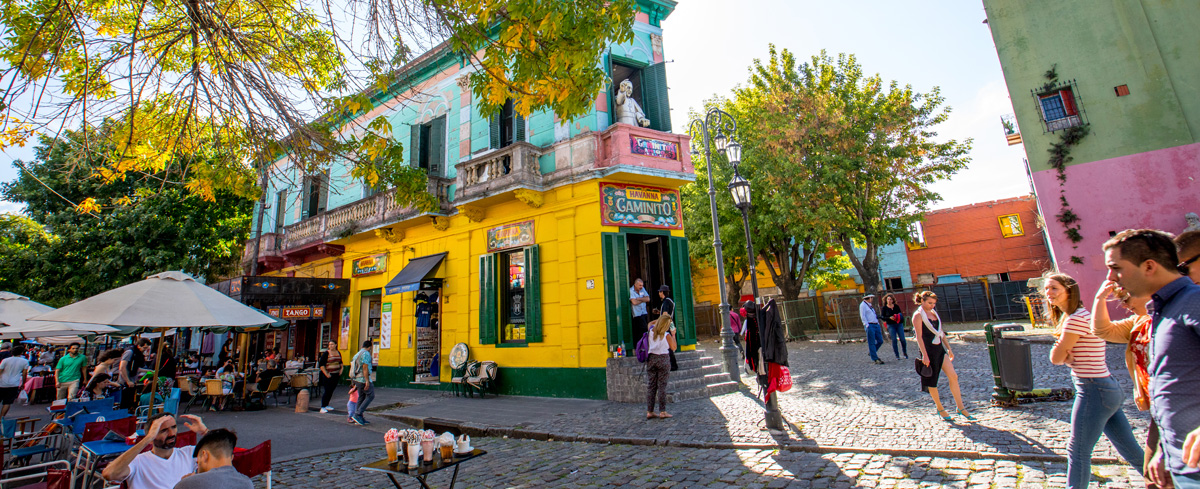
No. Pasaje Lanín is in Barracas, while Caminito is in La Boca. Both are associated with colorful public art, but they are different places with different histories.
Lanín is particularly associated with Marino Santa María’s abstract designs, mosaics and ceramic surfaces. Caminito’s identity is linked to Benito Quinquela Martín and its development as a street museum.
Seeing the two as distinct projects makes each more interesting. Rather than looking for another version of the same scene, you can notice how different artists brought color into the city.
For the story of that other colorful corner of Buenos Aires, read the history of Caminito.
Explore Buenos Aires through its art
Pasaje Lanín offers a way to look at the city through the work of an artist and the participation of a neighborhood. Its appeal is in the details: a curve around a window, a change in texture, or the way one façade leads your eye toward the next.
If this side of Buenos Aires interests you, explore my Buenos Aires street art tour. If visiting Pasaje Lanín is a priority, ask me whether it can be included in your itinerary.
Paola de Luca | Tu guia en BA.