The History of Caminito, Buenos Aires’ Colorful Street
Caminito is an open-air street museum in La Boca, Buenos Aires, known for its colorful façades and public artworks. Its transformation from an abandoned railway passage into a cultural landmark was driven by local residents and artist Benito Quinquela Martín. The street museum officially opened in 1959.
It is easy to notice the colors first. But behind them is a story about a port neighborhood, its community and an artist who believed that art belonged in everyday life.
Understanding that history changes how you see Caminito: the painted walls become part of a much larger story about Buenos Aires.
From a railway passage to an open-air museum
Before it became a pedestrian street, Caminito followed the course of a small stream that flowed toward the Riachuelo. Railway tracks later occupied the route, connecting this corner of La Boca with the area’s transport and port activity.
When the railway fell out of use, the passage deteriorated. What is now a familiar Buenos Aires landmark became a neglected space.
During the 1950s, residents began working to recover it. Among those involved were neighbor Aníbal Carrega and Benito Quinquela Martín, whose connection to La Boca would help give the project its distinctive identity.
Their efforts turned the former railway land into a place for art and community life. Caminito officially opened as a street museum on October 18, 1959. Rather than placing the collection inside a building, the project brought art into the street itself.
Why are the houses in Caminito so colorful?
Caminito’s appearance connects two parts of La Boca’s history: the neighborhood’s painted immigrant housing and Quinquela Martín’s deliberate use of color in public space.
La Boca developed around the port, attracting immigrants, including many from Genoa. Its characteristic conventillos were shared dwellings built with materials such as wood and corrugated sheet metal. The tradition of painting these homes in contrasting colors is commonly associated with using leftover paint from maritime work.
However, the colors of Caminito should not be understood simply as whatever paint happened to be available. Quinquela Martín actively selected colors for its façades, shaping the appearance of the street as an artistic project.
The Museo Benito Quinquela Martín’s archive documents his involvement in those choices. The painted buildings were part of his vision for the place, alongside the artworks installed along the passage.
That distinction matters: Caminito draws on the identity of La Boca, while also reflecting a conscious effort to preserve and reinterpret it through art.
Quinquela Martín’s vision for La Boca
Benito Quinquela Martín was one of the central figures behind Caminito’s transformation. His ambition extended beyond creating a picturesque street: he saw color as a way to improve everyday surroundings and strengthen the neighborhood’s identity.
For him, the street could become a shared cultural space. Walls, façades and outdoor artworks could bring art into the lives of people who might never enter a gallery.
That vision remains visible in Caminito’s sculptures and reliefs. Look beyond the painted buildings and you will find works connected to labor, music and the people of the neighborhood. The Museo Benito Quinquela Martín is responsible for safeguarding the street museum’s artistic heritage.
On a visit, take a moment to look at these smaller details. They help explain why Caminito is called a museum, even though you experience it by walking outdoors.
How did Caminito get its name?
Caminito means “little path” in Spanish. The street was named in tribute to the tango Caminito, with music by Juan de Dios Filiberto and lyrics by Gabino Coria Peñaloza.
There is an interesting distinction behind that connection: the path described in the lyrics was in Olta, in the Argentine province of La Rioja. It was not this street in Buenos Aires.
Quinquela Martín chose the tango’s name for the La Boca passage, bringing together the neighborhood’s visual identity and its musical associations. The song and the street became closely linked, even though the lyrics tell a story rooted elsewhere.
What can you see in Caminito today?
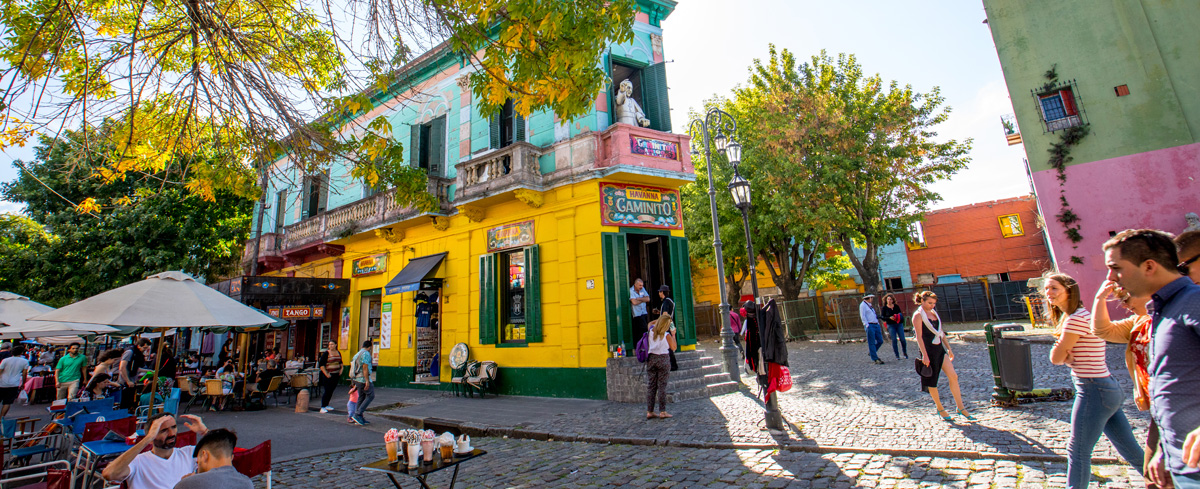
Caminito combines historic architecture, public art and visitor activity within a short pedestrian passage.
As you explore, look for:
- Colorful façades: contrasting painted surfaces, balconies and corrugated metal walls.
- Public artworks: sculptures and reliefs that form part of the street museum.
- Conventillo architecture: reminders of the shared housing associated with La Boca’s immigrant communities.
- Art and music: paintings, crafts and tango-related performances in the surrounding visitor area.
The street is compact, but its history rewards a slower look. Notice how the textures of the buildings interact with the colors, and how the artworks connect the setting to the neighborhood’s past.
Where is Caminito in Buenos Aires?
Caminito is in La Boca, in the southern part of Buenos Aires. One of its main reference points is the intersection of Dr. del Valle Iberlucea and Magallanes.
Caminito and La Boca are not interchangeable names: Caminito is a particular street within the much larger neighborhood. Visiting the passage offers an introduction to La Boca, but it is only one part of its history and identity.
If you are interested in another of the neighborhood’s landmarks, read why Boca Juniors’ stadium is called La Bombonera.
Explore the stories behind La Boca with me, Paola
Caminito’s colors catch your attention, but its history gives you reasons to stay curious. A former railway passage, a neighborhood initiative and an artist’s vision all come together in this small corner of Buenos Aires.
To explore the history and character of the city’s southern neighborhoods with a local guide, discover my La Boca and San Telmo tour.
Paola de Luca | Tu guia en BA.